
Figma vs. IBM: What Revenue Growth Trends Tell Investors About the Young Software Design Company and the Veteran Artificial Intelligence Tech Giant
 2026-07-25 22:15
•Robert Izquierdo •The Motley Fool
••••• ••
2026-07-25 22:15
•Robert Izquierdo •The Motley Fool
••••• •• Axe Capital view
Figma’s Growth Outpaces IBM, but SA Investors Should Stay Grounded
Figma’s steady revenue growth contrasts with IBM’s volatility, offering lessons on growth sustainability relevant to JSE investors.
Figma’s consistent revenue growth—46% year-over-year in Q1 2026 and eight straight quarters of gains—is impressive for a younger software company. For South African investors, it highlights how pure software and cloud-focused models can rapidly build value. IBM, by contrast, struggles with declining legacy hardware sales and uneven consulting revenue. That old-guard business model is dragging the company down, shown by a recent 42% drop in its mainframe segment and a 52-week share price low. While IBM still invests in AI, the market doubts its ability to pivot fast enough. On the JSE, this is a good reminder to prefer companies with clearer growth drivers over legacy complexity. For instance, Naspers and Prosus, with their heavy stakes in digital platforms, resemble Figma’s growth niche more than IBM’s mix. However, Figma’s valuation may be stretched, and a broad tech sell-off could spill over into growth-heavy stocks here. this is just my opinion and not financial advice
I’d watch Naspers and Prosus for growth exposure, given their digital focus, but be ready to trim on spikes. Avoid traditional tech or IT services firms within SA resembling IBM’s struggles.
- Naspers
- Prosus
- USD/ZAR
- Tech valuation correction hitting growth stocks
- Rand volatility weakening offshore earnings translation
7/10
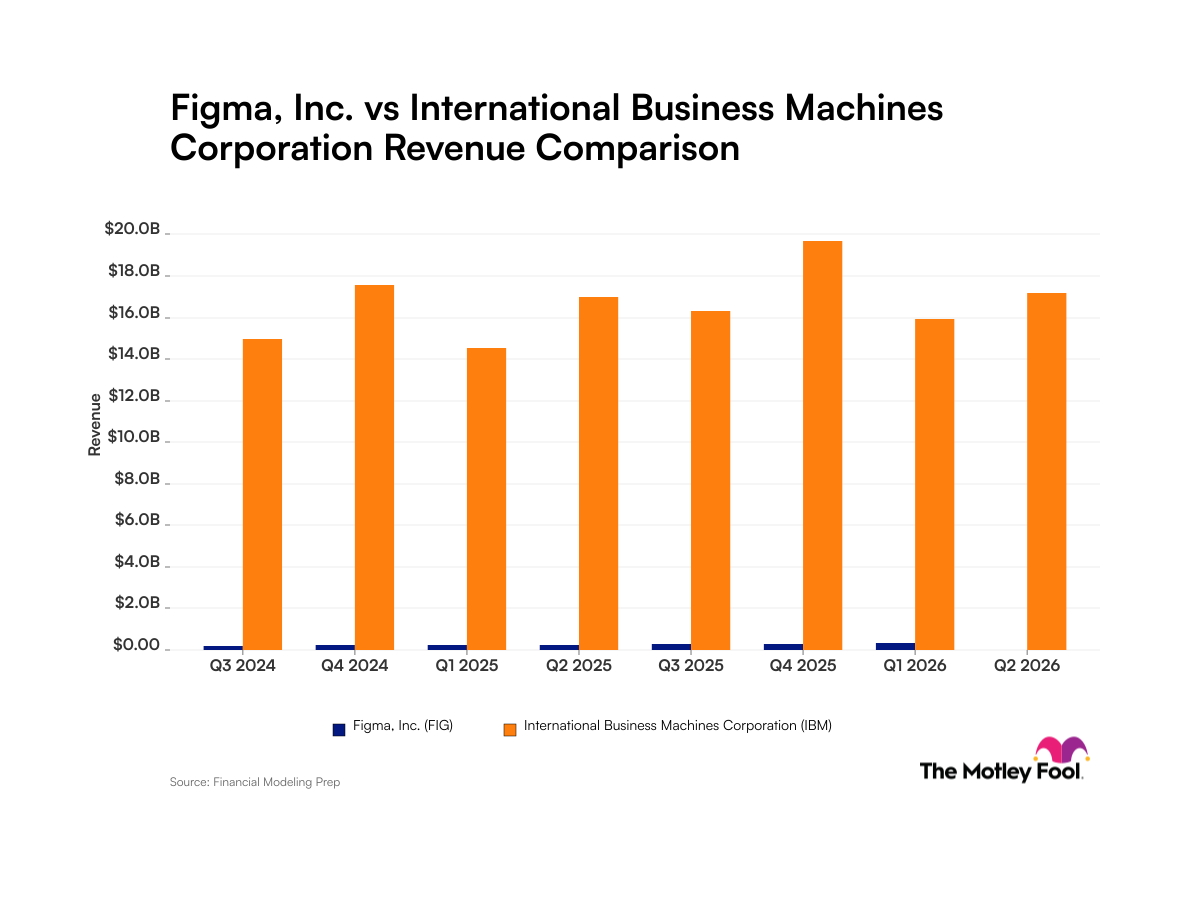
Figma demonstrates superior and consistent revenue growth with eight consecutive quarters of quarter-over-quarter increases, reaching $333.4 million in Q1 2026 with 46% year-over-year growth. In contrast, IBM experiences volatile revenue fluctuations tied to its hardware and consulting business, missing Q2 2026 revenue expectations and seeing its Z Systems mainframe sales decline 42% year-over-year, sending shares to a 52-week low.
This article was originally published by The Motley Fool and has been adapted here for Axe Capital Trading News.
Publisher: The Motley Fool
Author: Robert Izquierdo
Categories: Equities, Earnings, Technology, AI, Semiconductors
Tickers: FIG, IBM
Sentiment: Mixed - Figma demonstrates consistent quarter-over-quarter revenue growth across eight consecutive quarters with strong 46% year-over-year growth in Q1 2026. The company is successfully expanding its customer base despite market concerns about AI competition, with forecasted Q2 revenue of $348-350 million indicating continued momentum. IBM experienced volatile revenue performance with significant fluctuations between quarters, missed Q2 2026 revenue expectations, and saw its flagship Z Systems mainframe sales decline 42% year-over-year. The company's stock fell to a 52-week low of $199.19 on July 23, 2026, reflecting investor concerns about its ability to capitalize on AI growth.
Keywords: revenue growth, quarterly earnings, software design, artificial intelligence, cloud infrastructure, business momentum, market volatility
Insights:
- FIG: Positive: Figma demonstrates consistent quarter-over-quarter revenue growth across eight consecutive quarters with strong 46% year-over-year growth in Q1 2026. The company is successfully expanding its customer base despite market concerns about AI competition, with forecasted Q2 revenue of $348-350 million indicating continued momentum.
- IBM: Negative: IBM experienced volatile revenue performance with significant fluctuations between quarters, missed Q2 2026 revenue expectations, and saw its flagship Z Systems mainframe sales decline 42% year-over-year. The company's stock fell to a 52-week low of $199.19 on July 23, 2026, reflecting investor concerns about its ability to capitalize on AI growth.